


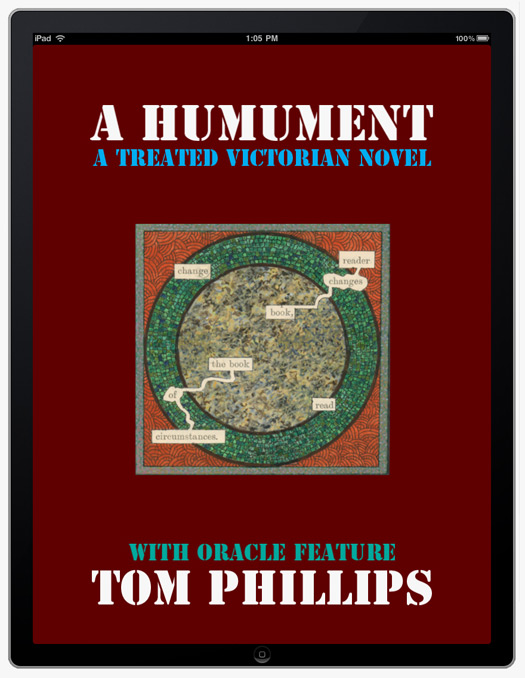
November 5, 2010
An App for the Self-Replacing Book
British artist Tom Phillips’ A Humument, based on an old Victorian novel, must be one of the most successful artist’s books ever published. Well before digital culture accustomed us to the idea that a project need never be finished and that it was mentally limiting to think in those terms, Phillips was creating a labyrinth of artfully altered, obscured and recast pages that seemed capable of indefinite revision.
A Humument — the neologism is a contraction of A Human Document, the title of W. H. Mallock’s 1892 novel — was first published as a private press edition in 1973. Then, in 1980, Thames & Hudson published a trade edition. Phillips revised the book again in 1987, 1998 and 2005, creating a miniature version, The Heart of a Humument, as well as other spin-offs, along the way. Eventually, he said, the work would completely replace itself.
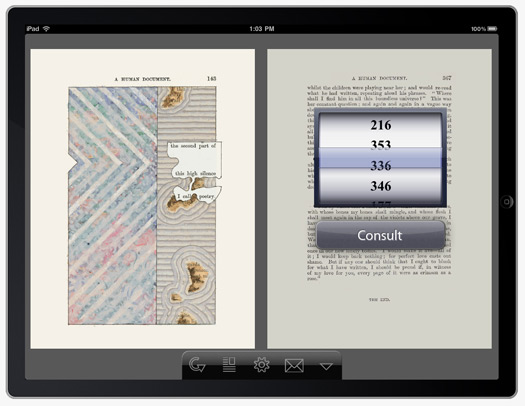
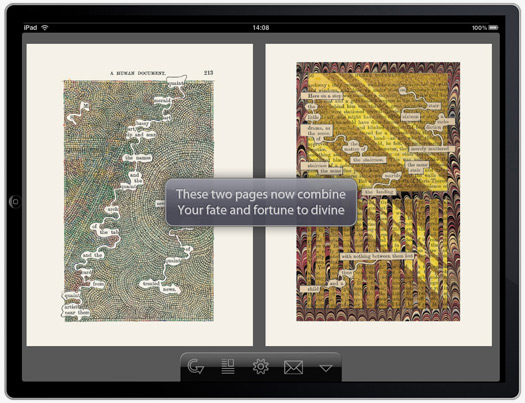
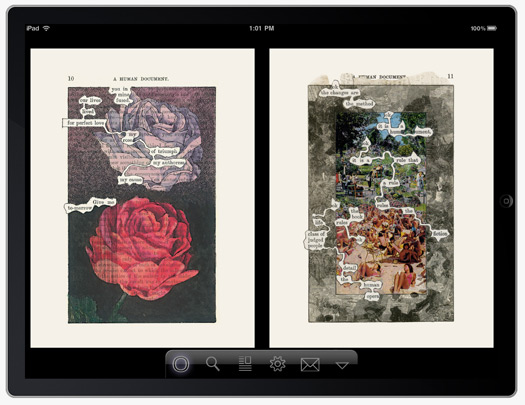
Now, in an entirely logical development, comes the Humument app for the iPad (released in mid-November). As well as 39 new pages unavailable elsewhere, the app has an interactive feature called The Oracle. Using a date and a randomly generated number, this gizmo selects two unrelated pages from the book’s 367 to be read at the same time. It’s also possible to zoom in and admire the rescanned images. It makes perfect sense to randomize the reading path of a book that has always inspired fortuitous dipping. Each hand-crafted page is a little work of art.
Observed
View all
Observed
Share on Social


By Rick Poynor
 Rick Poynor is a writer, critic, lecturer and curator, specialising in design, media, photography and visual culture. He founded Eye, co-founded Design Observer, and contributes columns to Eye and Print. His latest book is Uncanny: Surrealism and Graphic Design.
Related Posts
Business
Kim Devall|Essays
The most disruptive thing a brand can do is be human
AI Observer
Lee Moreau|Critique
The Wizards of AI are sad and lonely men
Business
Louisa Eunice|Essays
The afterlife of souvenirs: what survives between culture and commerce?

Architecture
Bruce Miller|Essays
A haunting on the prairie
Related Posts
Business
Kim Devall|Essays
The most disruptive thing a brand can do is be human
AI Observer
Lee Moreau|Critique
The Wizards of AI are sad and lonely men
Business
Louisa Eunice|Essays
The afterlife of souvenirs: what survives between culture and commerce?
Architecture
Bruce Miller|Essays