


March 18, 2011
Bad Faith Towers
From yesterday’s Times:
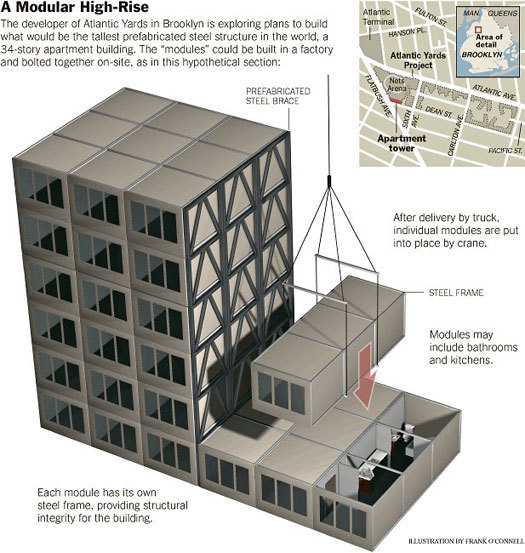
In a bid to cut costs at his star-crossed Atlantic Yards project in Brooklyn, the developer Bruce C. Ratner is pursuing plans to erect the world’s tallest prefabricated steel structure, a 34-story tower that would fulfill his obligation to start building affordable housing at the site.
The prefabricated, or modular, method he would use, which is untested at that height, could cut construction costs in half by saving time and requiring substantially fewer and cheaper workers. And the large number of buildings planned for the $4.9 billion Atlantic Yards — 16 in all, not including the Nets arena now under construction — could also make it economical for the company to run its own modular factory, where walls, ceilings, floors, plumbing and even bathrooms and kitchens could be installed in prefabricated steel-frame boxes.
Never let it be said that Bruce Ratner is not an avid follower of architectural trends. With this latest iteration of building at Atlantic Yards he swaps titanium for brown paper, correctly sensing that, post-recession, prefab is more palatable than starchitecture. Where once the Faustian bargain he offered Brooklynites appealed to their old school pride (a real city has its own sports team) and new Brooklyn snobbery (we could have had a Gehry before Manhattan), the new one is more pragmatic. Do you want affordable housing now, built fast and cheap, or later, when I wring a reduction in the number of promised units from the state?
The Times (for once) offers some distance from Ratner, development partner for their own Eighth Avenue tower, by pointing out that this new plan sells out the construction unions that were among Ratner’s biggest supporters. (Another sign of distancing: The paper also seems to be calling the project Atlantic Yards again, a site Ratner and his Russian partner rebranded Barclays Center.) The desirable industrial jobs that would come from the prefab plant required to build such a tower would pay much less than old-fashioned site work. Do we want green industry enough? Are we so desperate for affordable housing (again, the recession changes everything) that we will take a chance on untested building technology? Who gets to be the guinea pig on the 34th floor? Surely Forest City Ratner did not want this news out the week of the Japanese quake.

The image at top is just an illustration. Surely Ratner will tart up the prefab units with some cast concrete lintels and blown-up brownstone details, and call them contextual. But the truth is, the Times rendering is not so far from the boxy stacks Gehry proposed after the billowing Miss Brooklyn proved too costly. As with the disappointing 8 Spruce Street, there’s a thin value engineered line between industrial production and genius.
Observed
View all
Observed
Share on Social


By Alexandra Lange
 Alexandra Lange is an architecture critic and author, and the 2025 Pulitzer Prize winner for Criticism, awarded for her work as a contributing writer for Bloomberg CityLab. She is currently the architecture critic for Curbed and has written extensively for Design Observer, Architect, New York Magazine, and The New York Times. Lange holds a PhD in 20th-century architecture history from New York University. Her writing often explores the intersection of architecture, urban planning, and design, with a focus on how the built environment shapes everyday life. She is also a recipient of the Steven Heller Prize for Cultural Commentary from AIGA, an honor she shares with Design Observer’s Editor-in-Chief, Ellen McGirt.
Related Posts

Business
Kim Devall|Essays
The most disruptive thing a brand can do is be human
AI Observer
Lee Moreau|Critique
The Wizards of AI are sad and lonely men

Business
Louisa Eunice|Essays
The afterlife of souvenirs: what survives between culture and commerce?

Architecture
Bruce Miller|Essays
A haunting on the prairie
Related Posts
Business
Kim Devall|Essays
The most disruptive thing a brand can do is be human
AI Observer
Lee Moreau|Critique
The Wizards of AI are sad and lonely men
Business
Louisa Eunice|Essays
The afterlife of souvenirs: what survives between culture and commerce?
Architecture
Bruce Miller|Essays