


Ellen McGirt|Recommended Books, The Design of Horror | The Horror of Design
October 30, 2025
Booked and Blessed
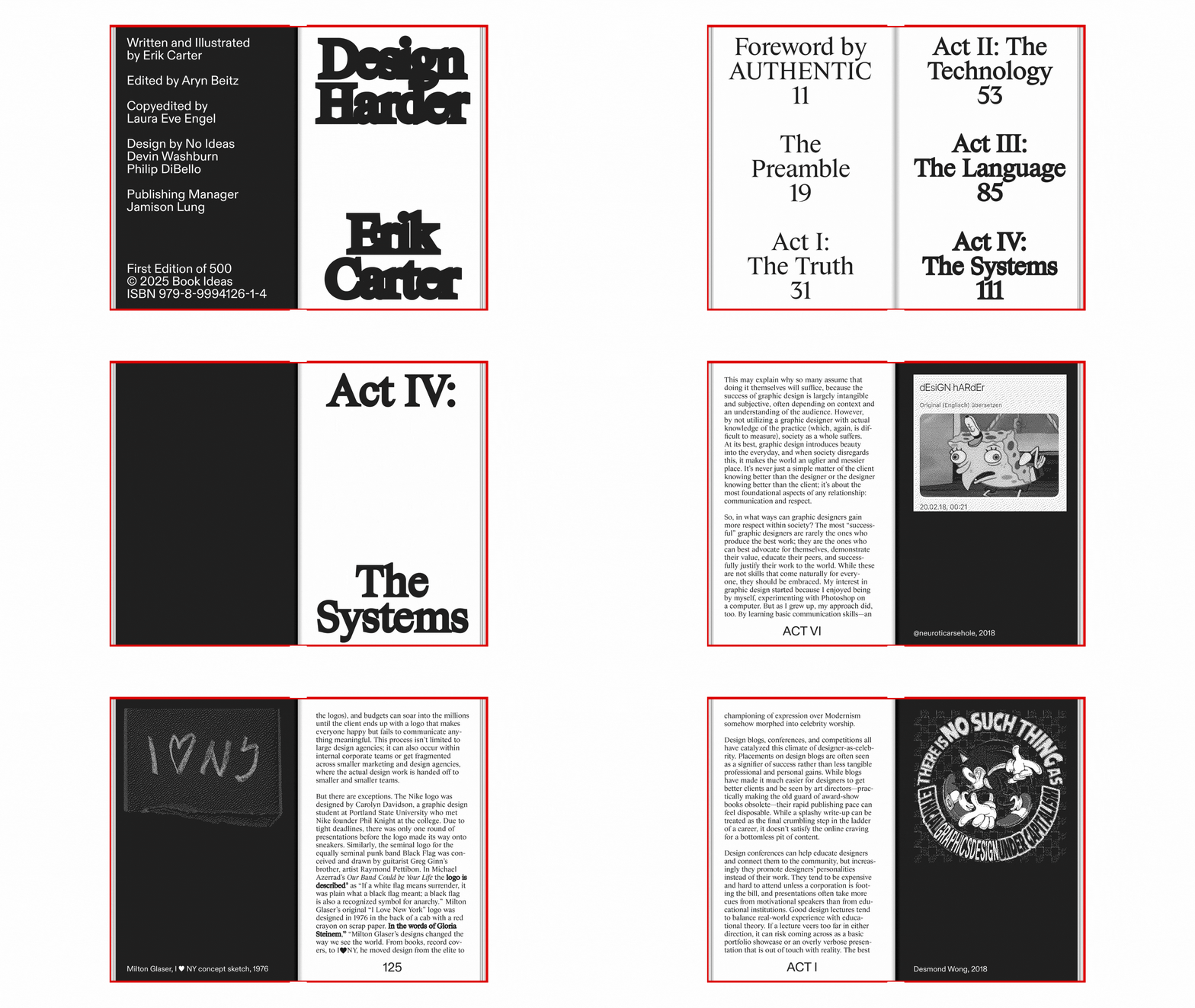
In Design Harder, Erik Carter dismantles modern graphic design with sharp wit, righteous fury, and a 10-point plan for creating work that actually matters.
Erik Carter did not come to play.
His new book, Design Harder, delivers what it promises: a dismantling of graphic design in seven (VII) acts.
“What has become of the profession that we call graphic design?” he begins. The designer, illustrator, and social commentator answers his own question: “What was once an anonymous intersection between art and industry that pushed for higher ideologies outside of the occupation has become a passive tool for targeted advertising fueled by venture capital, obsessed with the creators and less so the work.”
Carter goes on to deftly weave in modern graphic design’s origin story, the unexamined ethical and political implications of design work, his nasty breakup with Adobe, the unbearable sameness of logos, and the now seemingly unavoidable perils of late-stage capitalism.
Carter offers only two more acts than Shakespeare but triples the drama.
The book itself is a compelling object: small, red, sturdy. The cover is a typographic foghorn blast. It draws glances whenever I pull it out of my bag, like recently when I removed it to hunt for my wallet at the Piggly Wiggly. The young, tatted check-out person raised his eyebrows at the cover and smirked.
“Is the type supposed to be rage bait?” the author was recently asked on X. “Yes,” Carter replied, and credited someone named Normal Font Guy. The tatted person looked up from the book and gave me a sharp nod, the universal sign for fuck yeah. Designing harder seems like our only hope.
The impulse to write a book, really write one, feels like a radical act in a modern age, a bulwark against cynicism, a belief that ink and paper will hold on just long enough to become a signpost in the shifting sands. It doesn’t blink, click, comment, or try to capture your email: it is the collective commitment of a million edits, a thousand treasured ideas.
After a shamefully long absence, I began reading novels again this summer, searching for a peaceful, long-form place to spend my time while recovering from two shocking and unexpected deaths — my difficult sister and my dear brother-in-law — and packing up our family home to move 400 miles away to set up another. In my grief and tumult, my brain couldn’t pick a book or a genre, so I let random acts of algorithm — human or otherwise — guide my path.
My first attempt was The Nix by Nathan Hill, a recommendation from my late brother-in-law that I regretted not getting to while he was alive. It transported me in ways I didn’t expect; I followed that with Hill’s transcendent Wellness, then, at the advice of yet another person at yet another check-out line, I tried the audio version of Tom Lake by Ann Patchett, read by Meryl Streep, a person whose voice I never thought I would want in my head. Still, on those long drives filled with moving boxes and anguished mental to-do lists, I would have been happy to listen to her forever.
I’ve managed to finish 10 novels since June, almost none of which I would have chosen for myself. I loved every minute I spent in those fictional worlds, and I miss them daily. Thank you, and bless you, Audible. I like my brain on novels. I may not be exactly healed, but I am certainly saved.
And ready to design harder, in the real world.
I also spend a lot of time with designers, creatives, thinkers, and makers, and I have always enjoyed their impulse to turn their tools upon themselves to critique, defend, and build with, not for, others.
Carter’s 10-point plan to “design harder” begins with this rallying cry.
“While understanding and learning are crucial (knowledge is power!), we should constantly challenge and question all acquired knowledge of graphic design,” he writes. In the world that Carter would have us make, we would be fierce, do good work, and rethink our contribution to the status quo.
“Only by prioritizing quality, context, and the message of graphic design — while showing solidarity with society regardless of the harm to business — can we truly design harder,” he writes. I can totally hear Meryl saying that. Can’t you?
Ellen McGirt
Editor-in-Chief
ellen@designobservercombigscoots-stagingcom-cn.b.tempurl.cc
This is the web version of The Observatory, our (now weekly) dispatch from the editors and contributors at Design Observer. Want it in your inbox? Sign up here. While you’re at it, come say hi on YouTube, Reddit, or Bluesky — and don’t miss the latest gigs on our Job Board.
The Big Think

Fiction is a source of strength and inspiration for so many in the DO community.
“Often remembered as the birth of science fiction, Frankenstein is also a meditation on design: of bodies, of ambition, of creation itself,” writes poet Yahia Lababidi by way of explanation for his October reading list selection. “Shelley shows how the act of making without moral imagination breeds monsters. It calls every designer to reflect on the ethical and even existential dimension of what they bring into being.”
Lababidi knows his way around monstrosity. Now live on the DO site is his chilling essay (featuring an up-close-and-personal reading of his original poem) inspired by a visit to a Francis Bacon exhibition some years ago. On the heels of this month’s Louvre heist, it’s a timely take on his own hellish — and oddly heartening — encounter at a famed museum (the MET).
“What makes Bacon’s works captivating is that, in spite of their dark, often graphic nature, they signal a kind of faith, one that does not ask for mercy so much as recognition,” Lababidi writes. Read his full essay here.
Finally, all hail Design Observer’s own screen scream queen, executive editor Delaney Rebernik, who took her keen, slightly confessional insight to TIME to explain why scary movies can be so good for the anxious soul.
“I grew up scared of everything: death, the dark, my own face in the bathroom mirror,” she begins. “Eventually, I learned my bottomless fear belied several anxiety and anxiety-adjacent disorders that I’ve been addressing in adulthood with the help of therapy, medication, and an unlikely third salve: ravenous horror-film consumption.”
Stay tuned for the remaining entries for DO’s horror month, which will find their final resting place here in the coming days.

In the season finale of Design As, Lee Moreau talks with Patrick Whitney, an icon in design education, about how the discipline must evolve to meet the challenges of AI, climate change, and progress itself.
He also delivers his own view on the reason we need to “design harder:”
“‘Sales-oriented’ was measured by how much money you brought in by selling stuff. There was nothing to do with measuring how happy people were with what they bought. Design progressed and was brought into designing lines of products…and they put more and more energy into branding and sales and design for advertising, et cetera. And this was in the era of what would be called ‘design management’ … they started to look at it as a systems point of view. Then in the search for sales, they gave more attention to branding, and to the point where they forgot about the product.”
Listen here.
Happenings
The JournalismAI Festival, supported by the Google News Initiative, is November 11–12. It’s a free, in-person and online convening of journalists, editors, and media leaders designed to explore the practical applications and future of AI in journalism. More here. (JournalismAI is a project of Polis, the journalism think-tank at the London School of Economics and Political Science.)
The 2025 AICAD Symposium, “Engaging Values,” is November 12–14 at the Pratt Institute in Brooklyn. This year’s convening focuses on the intersection of values with art, design education, and practice. Registration and information here.
The Design + AI Summit is November 13–14, online. It’s an essential how-to event that helps designers leverage the power of AI to create high-quality work more efficiently, featuring 12 sessions from internationally renowned experts covering practical techniques for mastering generative AI tools. From the good people at Print Magazine.
Design Leadership Summit is November 17–19 in downtown Toronto. It’s a conference aimed at design leaders, promising talks, workshops, and roundtables “for design leaders who want frank dialogue and tactical playbooks.” Register here.
Marketing AI Institute is holding a virtual AI Agencies Summit November 20. Everything you need to know, here.
Fortune Brainstorm Design Conference is December 2 in Macau. Fortune’s premiere event explores the intersection of business, technology, and design. This year’s theme is “Future Tense: Prototyping Tomorrow.”
BODW or Business of Design Week is December 3–5 in Hong Kong. One of Asia’s major annual design/business events, the conference brings together creative and business leaders to talk innovation and brand strategy and do some broad design-industry networking. This year’s theme is “Curiosity Ignites Design Innovation.”
Observed
What are you observing? Tell us.
Praying for all in the path of Hurricane Melissa, the strongest storm on the planet this year. The Jamaican prime minister expects “major damage to our road infrastructure, bridges, drains, and possibly some damage to ports and airports.”
We’re all type designers now. Right? Elizabeth Goodspeed on why branding’s newest obsession is custom type. It’s an understandable, if not problematic, big swing. “They aren’t trying to become full-time type foundries exactly, but they are seeking more dominion over their typography,” she writes. “Increasingly, designers don’t just want to choose typefaces. They want to make their own. Big type, weird type, emotional type — they want it all.”
Designers are not falling for that AI okey doke. According to a new survey by UK-based research center DIGIT Lab, 81% of designers said they believe AI dulled creativity, compared to 63% of writers and journalists.
A hair-braiding robot created by Harvard students wins the top prize at the University’s start-up competition. Called Halo Braid, the robot was developed by Yinka Ogunbiyi and David Afolabi and designed to save time, protect stylists’ hands, and make braiding faster, easier, and more joyful.
Pepsi’s Mauro Porcini has signed on as Samsung’s first-ever design chief. “He’s got a hell of a job ahead of him,” says Wired’s Verity Burns.
German police bust an art forgery ring. Authorities in Bavaria said the main suspect is a 77-year-old German man, aided by a ring of some 10 alleged accomplices, including appraisers. All are facing charges of conspiracy and fraud. Among the paintings in question are forged versions of works by Picasso, Rembrandt, and Kahlo.
Is everything a “collectible” now? Kinda, according to the Art Basel & UBS Survey of Global Collecting 2025. Gen Z collectors report some 26% of their portfolios in collectibles, far outpacing other generations. “Their shopping carts look less like museum catalogues than lifestyle checklists: limited-edition sneakers, luxury handbags, cars, watches, and sports assets sit alongside digital and generative artworks.”
Serving as their new global headquarters, JPMorgan Chase’s new skyscraper ranks as the sixth-tallest building in New York City and the eighth-tallest in the United States. Some more bragging rights: the tower is expected to earn LEED Platinum certification, and as New York’s largest all-electric office tower, it produces net-zero operational emissions. It’s also pretty fancy.
Job Board
Senior Interior Designer at Ashli Mizell Inc., in Philadelphia, PA.
View all jobs here.
Yesterday and Today

The design critique of capitalism isn’t new. Matthew Wizinsky’s much-lauded 2009 book, Design after Capitalism, imagines a world where collaboration, craft, and care inform a more humane economic system.
“In Design after Capitalism, I argue for a deliberate transformation of design practices toward new forms of everyday politics, social relations, and economics. By assessing design through the lens of political economy, we can find pathways beyond current thinking and practices. Designers today are uniquely situated to combine entrepreneurship with social empowerment to facilitate new ways of producing the things, symbols, and experiences that make up everyday life.”
— Matthew Wizinsky
This is the web version of The Observatory, our (now weekly) dispatch from the editors and contributors at Design Observer. Want it in your inbox? Sign up here. While you’re at it, come say hi on YouTube, Reddit, or Bluesky — and don’t miss the latest gigs on our Job Board.
Observed
View all
Observed
Share on Social


By Ellen McGirt
 Ellen McGirt is an author, podcaster, speaker, community builder, and award-winning business journalist. She is the editor-in-chief of Design Observer, a media company that has maintained the same clear vision for more than two decades: to expand the definition of design in service of a better world. Ellen established the inclusive leadership beat at Fortune in 2016 with raceAhead, an award-winning newsletter on race, culture, and business. The Fortune, Time, Money, and Fast Company alumna has published over twenty magazine cover stories throughout her twenty-year career, exploring the people and ideas changing business for good. Ask her about fly fishing if you get the chance.
Related Posts
Business
Louisa Eunice|Essays
The afterlife of souvenirs: what survives between culture and commerce?
The Observatory Newsletter
Ellen McGirt|Fresh Ink
What happens when the social safety net disappears?

Arts + Culture
Alexis Haut|Interviews
How production designer Grace Yun turned domestic spaces into horror in ‘Hereditary’ and heartache in ‘Past Lives’

Architecture
Bruce Miller|Essays
A haunting on the prairie
Related Posts
Business
Louisa Eunice|Essays
The afterlife of souvenirs: what survives between culture and commerce?
The Observatory Newsletter
Ellen McGirt|Fresh Ink
What happens when the social safety net disappears?
Arts + Culture
Alexis Haut|Interviews
How production designer Grace Yun turned domestic spaces into horror in ‘Hereditary’ and heartache in ‘Past Lives’
Architecture
Bruce Miller|Essays