


October 15, 2015
Comic Bacteria
A wall in my third-grade classroom routinely displayed public health pamphlets and posters — some were nightmarishly frightening specters that left mental scars on impressionable little me and contributed to lifelong hypochondria.
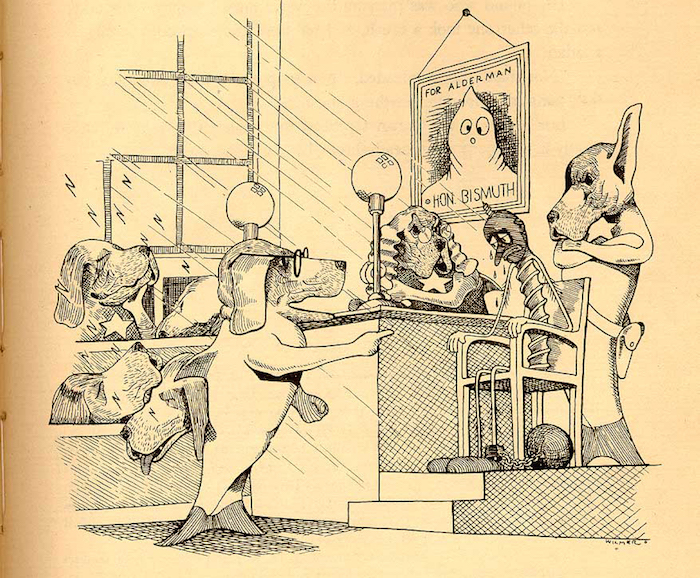
I recall the “Crusade Against TB” was symbolized by hooded demons or eerie skeletons but there was also a curiously comic character from the less shocking pamphlet titled Huber the Tuber: Story of Tuberculosis. Conceived, drawn and written in 1942 by Dr. Harry Wilmer for the National Tuberculosis Association, he also created Corky the Killer, a Story of Syphilis (American Social Hygiene Association).
Huber, comically guides the reader through otherwise serious information while Corky is what Time magazine called “a slightly bawdy blend of fact & fancy that seeks by cartoons and comic-strip dialogue to tell about the syphilis spirochete and how it works.”
Visually expressing complex information in reductive ways was not unique to Dr. Wilmer. In the twenties, Fritz Kahn’s diagramatic cross-section of a human male showed his insides resembling a factory buzzing with homunculi, or little people, who ran all the organs, muscles and reflexes. Kahn’s was rooted in science while the advertising industry created its share of symbolic trade characters that sold products through anthropomorphic imagery.
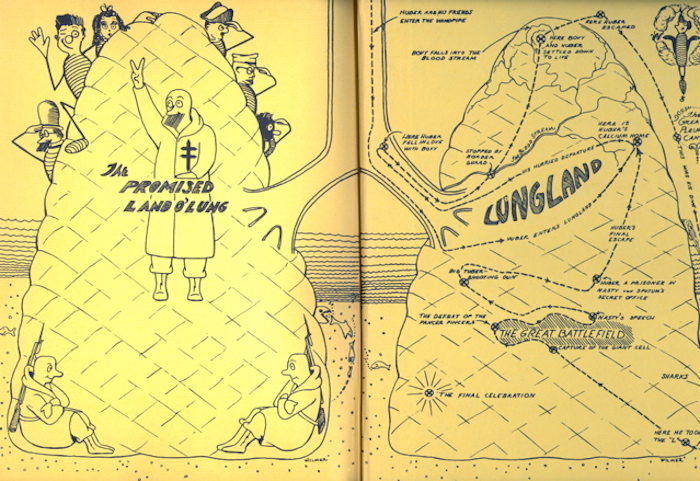
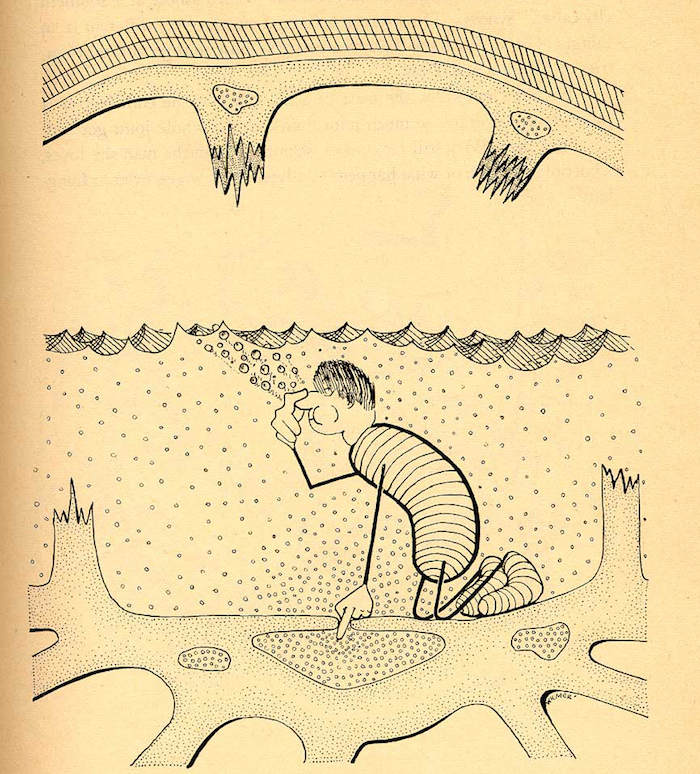
Creating comic avatars that stand in for disease, like Nasty von Sputum, Rusty the Bloodyvitch and Huey the Long Tuber, could be repulsive but Wilmer’s characterizations and accompanying text effectively taught users how tubercle bacilli is transmitted. The endpapers of Huber, showing “The Promised Land O’ Lung,” actually explains how TB prevention works.
In Dr. Wilmer’s Corky the Killer, the villain is a nasty spirochete 1/3000th of an inch tall, with a corkscrew body, a nose like a golf tee and spindly legs. The leader of “syphilitic saboteurs,” he is Mayor of Chancretown, whose anthem is “Down by the Old Blood Stream.” When antisyphilitic “magic bullets” are fired Corky makes a mad dash through the body and latches on to the first blood cell that floats by. Soon he finds his fellow saboteurs creating skin eruptions. Corky is finally arrested and tried. Loosing his case he is sent to the Soap and Water Chamber of Torture, where he is scrubbed to death. In this happy ending, Dr. Wilmer thwarts the foe with just a little practical hygiene.


Observed
View all
Observed
Share on Social


By Steven Heller
 Steven Heller is the co-chair (with Lita Talarico) of the School of Visual Arts MFA Design / Designer as Author + Entrepreneur program and the SVA Masters Workshop in Rome. He writes the Visuals column for the New York Times Book Review, a weekly column for The Atlantic online and The Daily Heller.
Related Posts

Business
Kim Devall|Essays
The most disruptive thing a brand can do is be human
AI Observer
Lee Moreau|Critique
The Wizards of AI are sad and lonely men

Business
Louisa Eunice|Essays
The afterlife of souvenirs: what survives between culture and commerce?

Architecture
Bruce Miller|Essays
A haunting on the prairie
Related Posts
Business
Kim Devall|Essays
The most disruptive thing a brand can do is be human
AI Observer
Lee Moreau|Critique
The Wizards of AI are sad and lonely men
Business
Louisa Eunice|Essays
The afterlife of souvenirs: what survives between culture and commerce?
Architecture
Bruce Miller|Essays