


Delaney Rebernik|Analysis, The Design of Horror | The Horror of Design
October 3, 2025
Mirror, mirror: The rise of ‘beauty horror’ amid today’s antifeminist backlash
With knockouts like “The Substance” and this year’s “The Ugly Stepsister,” the growing, woman-helmed subgenre stands 10 toes (give or take) down on its critiques of gender norms.
INT. GRAND VICTORIAN-ERA HOME – BEDROOM – NIGHT
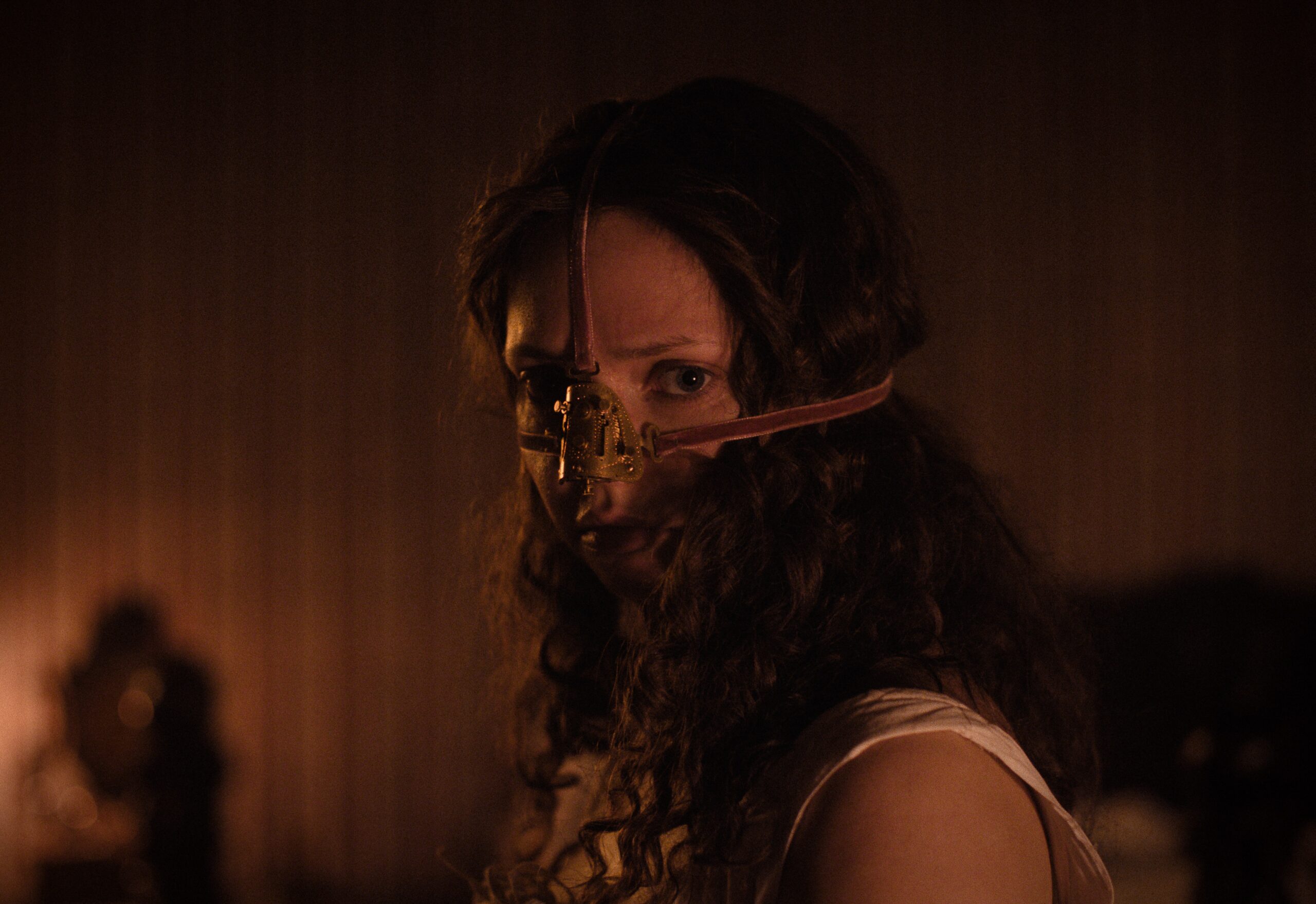
Elvira scans the lavish bedroom until her eyes, wide and rimmed with sparse, tear-slicked lashes, land on an ottoman. She drags it toward the edge of the four-poster bed and places a bare foot on it. With a log from the gently crackling fire in one hand, and a cleaver in the other, she peers over her emerald skirt and considers the toes jutting out from the stool’s edge. She balances the knife against the joints, pulls back the log to shoulder height, and, with a few rattling breaths, swings the wood down onto the blade. It’s a direct hit. Blood burbles up from the stricken digits, now mostly severed, save for a little tendon.
Elvira screams. Collapses.
Her mother, Rebekka, rushes in, takes it all in.
“There, there, my girl. Mama is here. You will be fine,” she says in soothing tones, stroking Elvira’s hair and plying her with a spoonful of a syrupy green sleeping concoction. She pauses for a moment, surveying the carnage. Then: “You’ve cut the wrong foot, my love. The Prince has the left shoe.”
As Elvira drifts into fitful sleep, Rebekka picks up the cleaver.
AND… SCENE
This desperate bid for the Prince’s affection, a key element in the Grimm brothers’ take on Cinderella from the 1800s, is here reimagined in excruciating detail in Norwegian filmmaker Emilie Blichfeldt’s debut feature, The Ugly Stepsister (2025). But in Blichfeldt’s version, there’s a key difference: the story is told not from the angelic Cinderella’s point of view, but from the titular ugly stepsister’s (enlivened by the inimitable actress and model Lea Myren).
“I wanted to make something that had a fairy tale feel, with the beauty and the dresses and the feminine touch. But then have the horror,” Blichfeldt told Script.
Mission accomplished.
Blichfeldt’s film, which premiered at the Sundance Film Festival in January, is among the latest critically acclaimed contributions shaping today’s “body horror” renaissance. The subgenre, which has roots in early Gothic literature but was popularized in the 1980s with films like The Fly, explores the limits and transformative potential of the human body through grotesque or disturbing imagery. And now, an important, woman-helmed sub-sub-genre is orchestrating the rebirth: “Beauty horror,” coined by Blichfeldt, riffs on the truism that “beauty is pain.” It’s a fitting moniker for a body of work exploring, with visceral acuity, the fraught, often ugly reality of being a woman in a body.
“I[t] felt really good to see the toes cut,” says So Yeon Leem, PhD, assistant professor at Dong-A University in Busan, South Korea. Leem researches the intersection of gender, ethics, and technology, and is a recent convert to horror thanks to films like The Ugly Stepsister and The Substance. “Maybe it’s just catharsis,” she says. Leem underwent an elective “two-jaw surgery,” which is popular in South Korea, she says, because it creates a balanced, youthful V-curvature in the face, and makes professionals in certain industries more competitive in the job market. “A small jaw is not intimidating compared to a big jaw,” she explains. “That’s a really important point. You don’t want to intimidate, especially men, if you are a woman. … [You] shouldn’t look too strong.”
But the procedure isn’t for the weak. Leem had teeth pulled and bones shaved down, decisions that are irreversible, she notes. “That has been the fear.” She recalls the thick bandages all over her face, and braces wiring her jaw shut. The loss of the ability to open her mouth for two weeks.
Leem is hardly alone.
The “forever-35 face” is in vogue, thanks to luxury facelifts priced upward of $200,000. Globally, nearly 38 million aesthetic procedures were performed in 2024 — a 40% increase from 2020, says the International Society of Aesthetic Plastic Surgery. By recent counts, the US performs the most (over 6.1 million last year), but, when it comes to per capita surgeries, South Korea leads, with about 8.9 in 1,000 people going under the knife in 2021. (The growing 4B movement, marked by young Korean women defying “societal expectations of marriage, motherhood and heterosexual relationships,” was built in part by collective resistance to such a surgery culture.)
It makes complete sense that this booming industry is in the horror crosshairs, says Payton McCarty-Simas, a film critic and author who studies the cyclical rise and fall of the cinematic witch in American culture. “The body standards are changing. We’re bringing back Anorexia Chic and Slutburger aesthetics at the same time. I saw that cocaine was back.”
A scary-good year for horror
Though genre aficionados have yet to coalesce around “beauty horror” as a term outside of Reddit and Blichfeldt’s interviews, the subgenre is taking off globally thanks to last year’s smash success, The Substance, the Demi Moore vehicle in which a fading actress tussles with a mysterious serum to become a “younger, more beautiful, more perfect” version of herself on the heels of her unceremonious firing — on her 50th birthday, no less — by her chauvinistic network-exec boss (Dennis Quaid).
Female filmmakers finding success in body horror is a recent phenomenon, but one with historical heft, says McCarty-Simas. They argue that women are the unsung shapers of the 1990s’ New French Extremity subgenre, known for its graphic, transgressive depictions of (often sexual) violence.
“The idea of abjection has always been associated with the female body, because of reproduction and birth and the changes that the female body goes through,” they explain. “It’s a completely natural fit.”
Sasha Rainbow, director of Grafted, agrees. The 2024 film features a Chinese exchange student (Joyena Sun) who’s willing to do some, uh, serious skin grafting to embody the pretty, popular girls in her New Zealand host town.
“We know blood. We know gore. We have to be very in touch with our bodies all the time. Of course this genre works for us,” Rainbow told Offscreen Central. “But it doesn’t fit the brief for how women are meant to behave in society and how we have been depicted throughout history. I think we finally got to the point where we have platforms to actually share the truth.”
And the timing is right: Horror movies have already surpassed $1 billion at the US box office this year, Vox reported in September, a feat that hasn’t been accomplished since 2017 (when Jordan Peele’s Get Out and Andy Muschietti’s It redux premiered). TikTok has seen a similar spike in horror-related content, the BBC said in July.
Beauty politics
Aside from reflecting the crop of absolute bangers that have hit the big screen this year (Sinners, Weapons, Final Destination Bloodlines), horror’s recent commercial success has a lot to say about the geopolitical moment. “Times of ‘chaos and uncertainty’ in the wider world tend to boost the genre,” journalist Ash Millman told the BBC.
These times also, says McCarty Simas, determine what monstrous women look like.
“We have returned to a kind of aesthetic that you see during periods of anti-feminist backlash, where witches cease to be sexy, and return to the kind of cartoon crone,” she explains, a la the 1980s. “It’s the kind of stuff that’s meant to put you off guard … and it’s a distancing from the political elements of the genre.”
Take, for example, Zach Cregger’s box office (and marketing) sensation Weapons, which documents the aftershocks in the fictional town of Maybrook, Pennsylvania, from one mysterious night in which 17 children from the same classroom run away at exactly 2:17 am.
We learn Gladys (Amy Madigan) — the supposed aunt of Alex (Cary Christopher), the lone child from the class who remains accounted for — is an ailing witch siphoning life force from the suburbanites. And with her baby bangs, barely-there teeth, and over-painted lips, she certainly looks the part. Her downfall comes when Alex breaks her spell over Maybrook, and all the missing kids she’s kept harbored in the basement attack her. “The overtly feminist horror monster that is the witch is getting torn apart by children,” says McCarty-Simas.
Compare that to periods of “heightened feminist activism,” like the 2010s, in which we see “genuinely scary, genuinely erotic figures who are capable of enacting devastating change in the world,” she explains. She points to Anya Taylor-Joy as Thomasin in Robert Egger’s The Witch (2015). “It’s an expression of a masculine fear that feminism can actually cause change, right?”
And a core part of that expression is beauty.
“Those women are beautiful, and that’s part of why they’re scary,” McCarty-Simas explains. “Because the image of a beautiful woman misbehaving, even though she theoretically has it all in the system in which we exist, is part of her danger. She chooses to opt out and resist the male gaze that she still attracts.”
Fallen angels
Beauty horror is also bound up in broader themes of domesticity that thread today’s films featuring monstrous women. As reproductive rights are rolled back and tradwife content surges, our horror (anti)heroines are also defined by their conformity with — or defiance of — traditional gender roles, such as homemaking and mothering.
In Egger’s 2024 Nosferatu remake, for example, Lily-Rose Depp’s Ellen Hutter is “what the Victorians would call the angel of the home, and even though she has a darkness, she sacrifices herself for her man,” McCarty-Simas says.
Other, sometimes fallen, angels include Elvira’s mom Rebekka in The Ugly Stepsister and — perhaps surprisingly — Iris (Sophie Thatcher) in Drew Hancock’s Companion (2025), says McCarty-Simas.
“Follow the rage,” they say. “Who is it directed at? Where is it going? And where does it come from? And right now, that rage is not doing the same things that it did even five years ago. It’s not directed necessarily at the patriarchy.”
Though Iris ultimately gets revenge over her oppressor (played by beauty-horror scion Jack Quaid), she seeks it not because of her subjugation as a tradwife fembot whose every move and thought he controls, but because “she loves him, and she’s betrayed,” McCarty-Simas says. “She’s fighting for her life and her autonomy, but it’s not systemic.”
And beauty, though personal in application, is nothing if not systemic in its implications, says Blichfeldt.
“I wanted to make a story where people would sympathize, or at least empathize, and understand why someone would chop off her toes to fit the shoe,” she told RobertEbert.com. “If it hadn’t been for the people who had told me, ‘What you’re doing to yourself is not healthy; please, I will lend you my gaze to see the world differently, because how you’re seeing it is hurtful to you…’ That is so important. And this is not something we can overcome by ourselves, although it feels like a personal, private thing to deal with. It’s a much bigger theme that we as a society must tackle together.”
For Leem, that means holding up a mirror to the stark, messy realities of meeting societal standards.
“I witnessed my own experiences, my own anxiety, my own pains. Of course, my own happiness. It’s good and bad, both,” says Leem of her jaw procedure. “I don’t want to teach anybody, or any woman, not to have surgery, or to go for surgery without any fear. … I just want to talk about it all together — talk about why we need to change our body and [about] these beauty practices. So to do that, first, we need to see the same thing.”
Observed
View all
Observed
Share on Social


By Delaney Rebernik
 Delaney Rebernik is Design Observer’s Executive Editor. She’s also an independent journalist covering death and digital life, and a writer and consultant for purpose-driven organizations. As an award-winning editorial and communications leader, Delaney helps media brands; memberships; and other champions of community, knowledge, and justice tell vital stories and advance worthy missions. In her spare time, she consumes (and riffs on) horror and musical theater in equal measure. She lives in Brooklyn, New York, with her husband Todd and pup Spud, named for her favorite food. Learn more at delaneyrebernik.com, and connect on Bluesky and LinkedIn.
Related Posts
AI Observer
Dave Snyder|Analysis
The identity industrialists
AI Observer
David Z. Morris|Analysis
“Suddenly everyone’s life got a lot more similar”: AI isn’t just imitating creativity, it’s homogenizing thinking
AI Observer
Stephen Mackintosh|Analysis
Synthetic ‘Vtubers’ rock Twitch: three gaming creators on what it means to livestream in the age of genAI
AI Observer
Raphael Tsavkko Garcia|Analysis
AI actress Tilly Norwood ignites Hollywood debate on automation vs. authenticity
Related Posts
AI Observer
Dave Snyder|Analysis
The identity industrialists
AI Observer
David Z. Morris|Analysis
“Suddenly everyone’s life got a lot more similar”: AI isn’t just imitating creativity, it’s homogenizing thinking
AI Observer
Stephen Mackintosh|Analysis
Synthetic ‘Vtubers’ rock Twitch: three gaming creators on what it means to livestream in the age of genAI
AI Observer
Raphael Tsavkko Garcia|Analysis