


May 21, 2010
On Fast Company: Why Do Designer Toys Suck?
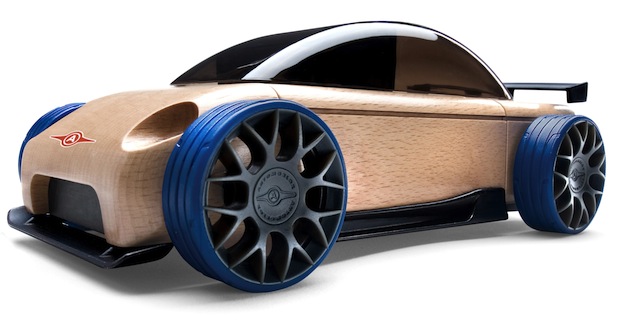
Their headline, not mine. But seriously, spare me the good-looking trophy toys. I’ll take an operational plastic garbage truck any day.
It was perhaps the fifth or sixth time I found myself, flat on the floor, arm extended, sweeping a broom under the couch to try to retrieve the quarter-size wheels of my son’s Automoblox Minis that I thought, “This is not a good design.”
Everything about them looked great. Automoblox share the traits of many toys sold at Giggle, the MoMA Design Store, and the overpriced kids boutique in your neighborhood: They are made of wood, the colors are bright and unisex, they use no batteries, they evoke the past, and they cost significantly more than the plastic, pink-or-blue, light-blinking, noise-making blobs sold at Toys R Us. These qualities explain why three different people decided Automoblox were the ideal gift for the offspring of an architect and a design critic.
Read the rest here.
Observed
View all
Observed
Share on Social


By Alexandra Lange
 Alexandra Lange is an architecture critic and author, and the 2025 Pulitzer Prize winner for Criticism, awarded for her work as a contributing writer for Bloomberg CityLab. She is currently the architecture critic for Curbed and has written extensively for Design Observer, Architect, New York Magazine, and The New York Times. Lange holds a PhD in 20th-century architecture history from New York University. Her writing often explores the intersection of architecture, urban planning, and design, with a focus on how the built environment shapes everyday life. She is also a recipient of the Steven Heller Prize for Cultural Commentary from AIGA, an honor she shares with Design Observer’s Editor-in-Chief, Ellen McGirt.
Related Posts
Business
Kim Devall|Essays
The most disruptive thing a brand can do is be human
AI Observer
Lee Moreau|Critique
The Wizards of AI are sad and lonely men
Business
Louisa Eunice|Essays
The afterlife of souvenirs: what survives between culture and commerce?

Architecture
Bruce Miller|Essays
A haunting on the prairie
Related Posts
Business
Kim Devall|Essays
The most disruptive thing a brand can do is be human
AI Observer
Lee Moreau|Critique
The Wizards of AI are sad and lonely men
Business
Louisa Eunice|Essays
The afterlife of souvenirs: what survives between culture and commerce?
Architecture
Bruce Miller|Essays