


August 22, 2025
Say it with your chest: WNBA players fight for pay and justice on their t-shirts
Earning just 9% of league revenue, players push for fairness on and off the court
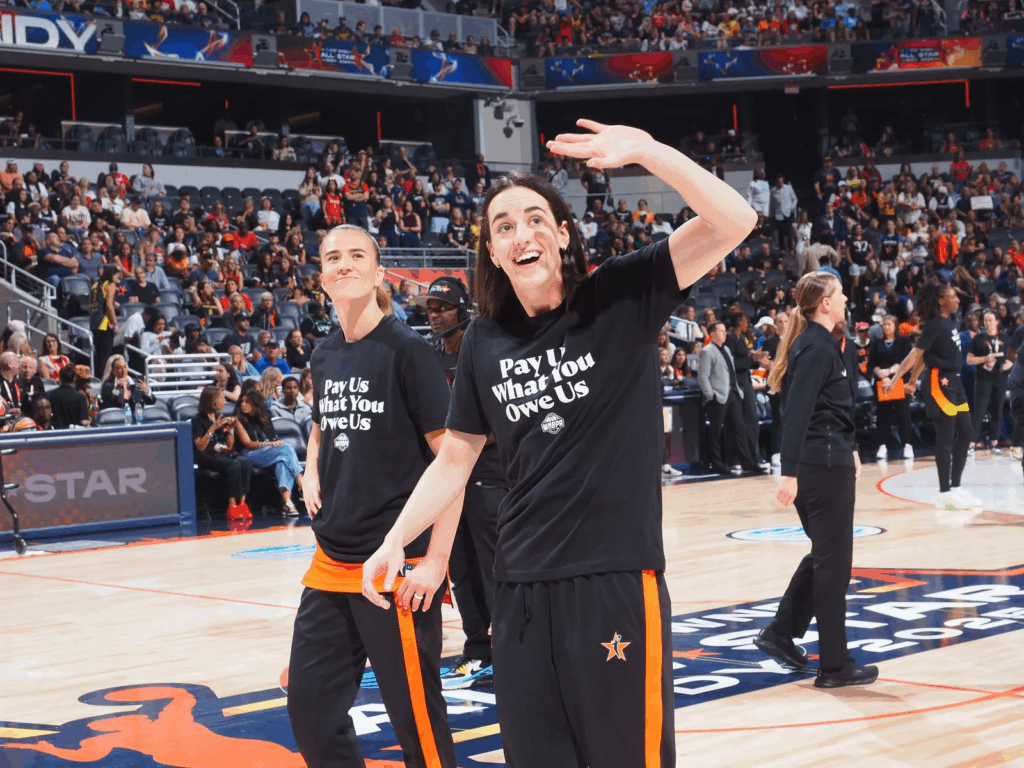
On a Saturday in late July, the 26 designated All-Stars of the Women’s National Basketball Association (WNBA) streamed onto the court at Indianapolis’ Gainbridge Fieldhouse for warmups with a bold message on their chests: Pay us what you owe us.
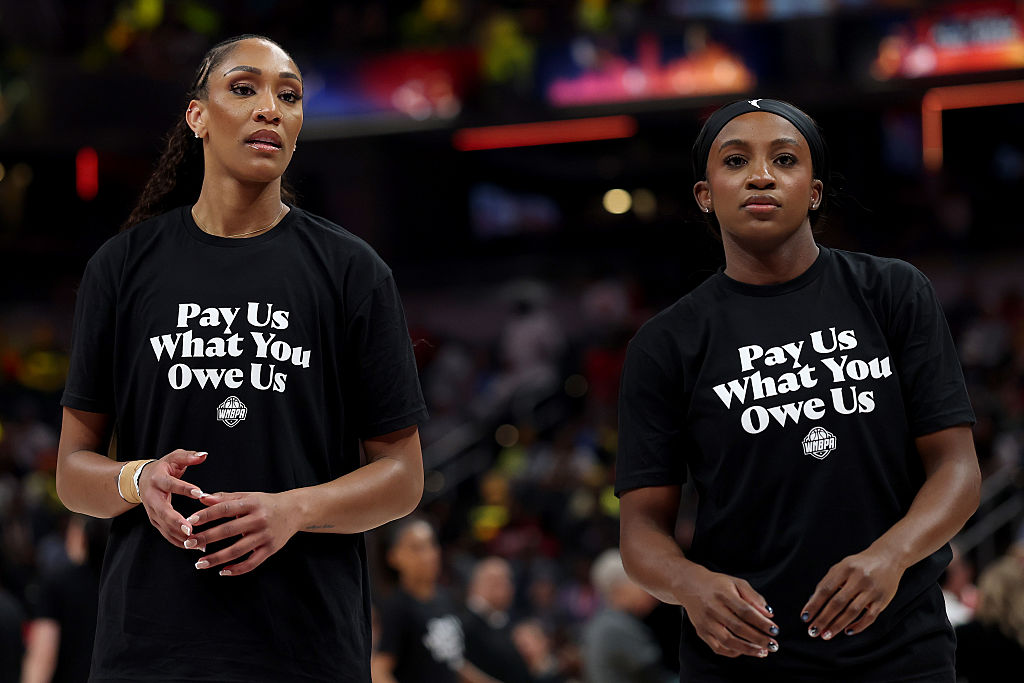
The emblazoned tees are the latest action in the fight for a new collective bargaining agreement (CBA). The players, in partnership with their union, the Women’s National Basketball Player’s Association (WNBPA), opted out of their current CBA three years before it was set to expire due to a stagnant growth rate in player compensation that was established before the league’s astronomical growth over the past three seasons.
“The world has evolved since 2020, and we cannot afford to stand still. If we stay in the current agreement, we fall behind,” former league MVP and WNBPA president Nneka Ogwumike told ESPN following the decision to opt out last October.
Though the players have a number of asks on the table, there is one non-negotiable: that they are paid what they are owed.
The average WNBA salary in 2024 was $127,000, and the rookie salaries for top draft picks (which in 2024 included phenoms Angel Reese and Caitlin Clark) was around $76,500. For comparison’s sake, the average NBA salary is $10 million a season, a discrepancy that revered labor activist Claudia Goldin calls “embarassing.” Aside from their salaries, W players share in about 9% of the league’s revenue, a tiny slice compared to the 50% NBA players receive of their league’s earnings.
The t-shirt play followed a disappointing meeting that took place the Thursday before the All-Star game. More than 40 players met with WNBA commissioner Cathy Engelbert and other league officials about the state of the new CBA. Both sides have been tight-lipped about the specifics, but the WNBPA have told media members that the negotiations around player compensation are at a standstill. Former league MVP Breanna Stewart called the discussion a “wasted opportunity.”
“We had conversations…about doing some sort of demonstration,” Minnesota Lynx star and WNBPA Vice President Napheesa Collier told Megan Rapinoe and Sue Bird on their podcast A Touch More. “And something that the W has done is shirts.”
It’s true. In 2016, the Minnesota Lynx wore shirts reading “Justice and Accountability” to their pre- and post-game media appearances following the murder of Philando Castile in a Minneapolis suburb. Throughout the 2022 season, players wore various shirts in support of Brittney Griner after she was detained while playing overseas in Russia.
WNBAers don’t have the luxury of just focusing on basketball. In a league where most of the players are Black and many are queer, these athletes symbolize the fight for social progress, making them heroes to some and villains to others. That vulnerability is what makes the W’s use of protest t-shirts so powerful. Players’ bodies are feats of athletic wonder and targets for misogynistic ire, so why not reclaim them as billboards for what they think matters most? Ahead, find some of the league’s most iconic protest-shirt campaigns of the past decade.
“Pay us what you owe us”
What WNBA players are financially “owed” has been a hot topic since the league’s inception in 1996, and the image of these women fighting for their worth has dredged up some of the bro-internet’s greatest hits. Since All-Star weekend, Instagram comments and podcast transcripts have been littered with claims that the W is simply the NBA’s charitable project, and that since the league has yet to turn a profit, the players have no right to ask for a raise.
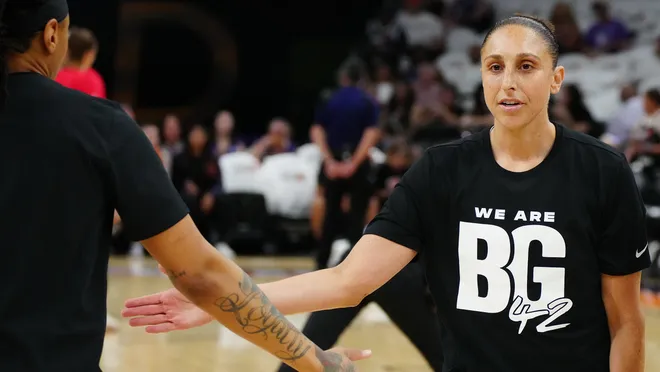
Disproving these specious claims in full is beyond the scope of this essay, so here are the headlines: the NBA does put an undisclosed amount of money toward the W’s operating costs. It also owns 42% of the women’s league, meaning it receives almost half of its revenue. And in terms of profitability, no one actually knows how profitable the W is because NBA and W officials refuse to share that information. And since when does a company have to be profitable to give their employees a raise? (The Athletic’s No Offseason podcast has some excellent breakdowns of how money works in the WNBA.)
While we don’t know how much money the league pockets, here’s what we do know: in 2024, the WNBA signed a blockbuster media rights deal worth $2.2 billion; this past spring, the league collected a $250 million expansion fee from three new franchises; and as 2025, at least five current WNBA franchises are worth over $300 million. So, some people are making money — just not the players. All-Star weekend offered the perfect blend of proximity and attention to shine a spotlight on these discrepancies, with more than 2.2 million people tuning in to this year’s game.
“Arrest the cops who killed Breonna Taylor”
During the 2020 pandemic season, the W was relegated to the IMG Academy in Bradenton, Florida. Teams, alongside their families and a few media members, were holed up at the academy hotel for most of that summer. According to the players, it felt strange to carry on a basketball season as the country erupted into unrest. They told the league they would dedicate the season to social justice or they wouldn’t play at all.
Some players served as spokespeople for the league’s movement, participating in interviews and posting on social media in support of the nationwide protests against police violence. But the most visible of their protest vehicles was the t-shirt.
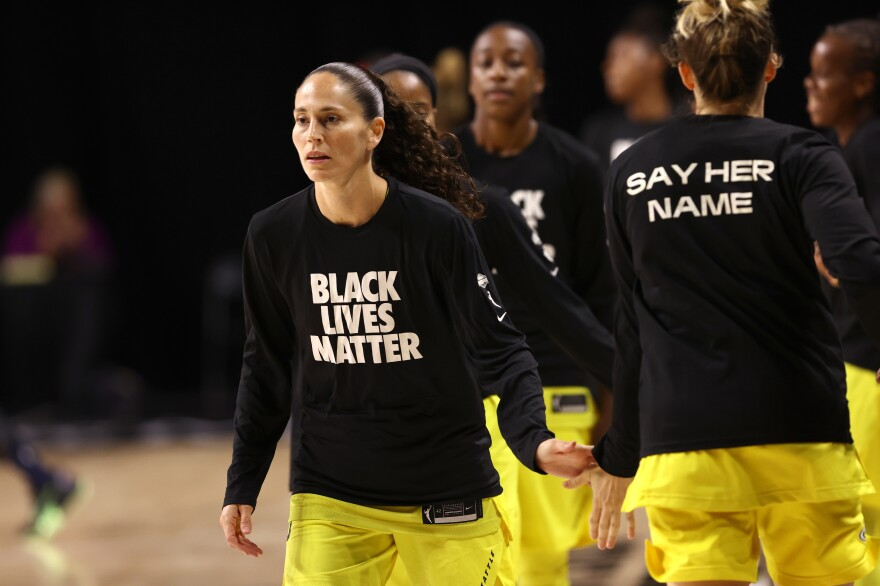
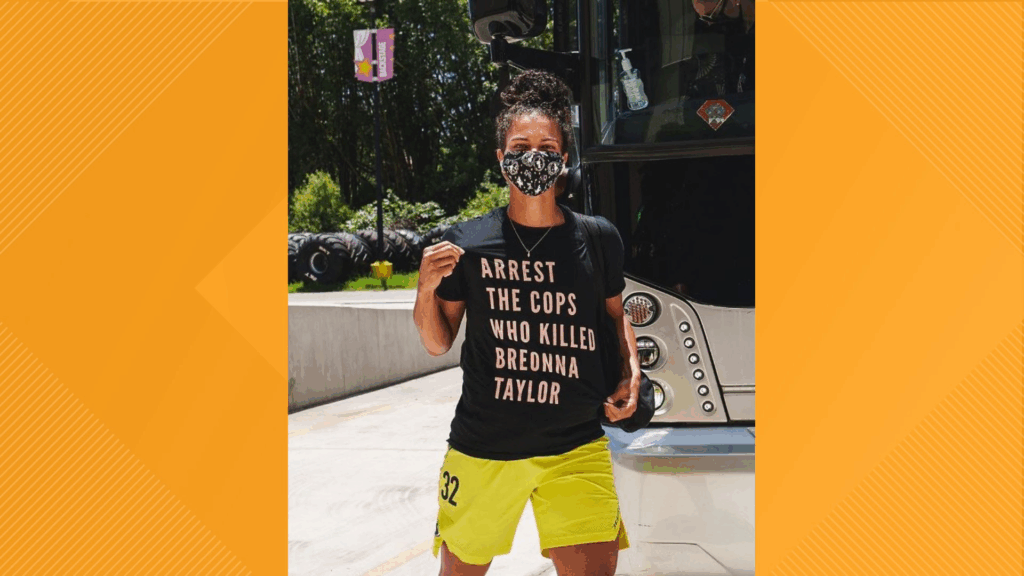
To start the season, all 12 teams warmed up in “Black Lives Matter” tees. As the summer progressed, their messaging became more specific. Players wore shirts emblazoned with “Arrest the cops who killed Breonna Taylor” on the front and “Say her name” above an airbrushed image of Taylor on the back.
“Vote Warnock”
As summer turned to fall, and a consequential election neared, the WNBA’s t-shirt message boiled down to one word — Vote! — an encouragement that soon became a pointed call to action and ultimately flipped a Senate seat.
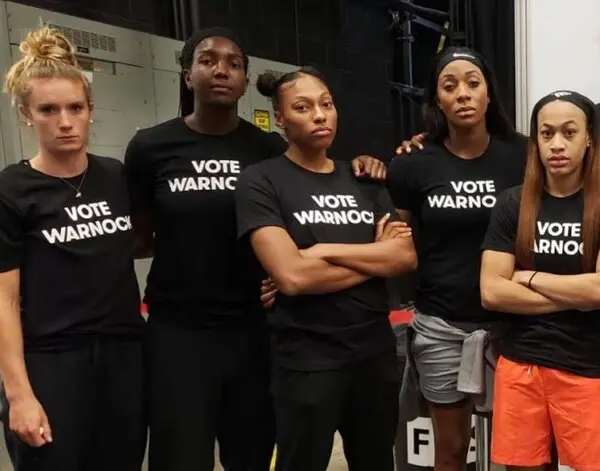
After former Atlanta Dream owner and Georgia Republican Senator Kelly Loeffler sent a letter to Cathy Engelbert calling the league’s commitment to Black Lives Matter “divisive” and “Marxist,” the players showed up to their pre-games wearing black t-shirts urging viewers to “Vote Warnock.”
Then virtually unknown outside of Georgia, Reverend Raphael Warnock was running against Loeffler in the 2020 Senate race. After speaking with Stacey Abrams and interviewing Warnock themselves, a committee of players agreed the candidate aligned with their values.
The WNBA became Warnock’s most effective campaign tool, shooting his public profile into the stratosphere and leading to his win against Loeffler. Seriously. Research by Yale University Ph.D. candidate Angele Delevoye found that Warnock’s campaign brought in 20 percent more in donations, equivalent to a $40,000 increase, in the 48 hours following the WNBA players’ “Vote Warnock” t-shirt endorsement.
“Pay them what you owe them”
A t-shirt is a simple, effective way to let people know what you stand for. It’s a means of communication that is available to everyone, not just professional athletes. But when you are a star athlete, your reach is wide and whatever is written on your tee will be discussed and dissected. And if you play in a women’s league, Lord knows you’re vulnerable to criticism, harassment, and haters.
The WNBA is so special and its stakes are so high because the players’ fight mirrors our own. Since All-Star weekend, fans across the country have been showing up at arenas in t-shirts with their own message for the league: “Pay them what you owe them.”
It will be interesting to see if the increased public awareness will influence the CBA negotiations. The current agreement expires on October 31, weeks after the 2025 Finals have wrapped and the champions are crowned. To follow will likely be a long off-season of contentious negotiations before the 2026 season begins in May.
Much remains uncertain, but one thing we can count on is that these players will not settle. A few have said that a work stoppage isn’t off the table. And it wouldn’t be surprising if they were wearing matching t-shirts when they walk out. If we’ve learned anything from these players, it’s the power of saying something with your chest.
For additional insight into the WNBA’s approach to talent, activism, and the business of basketball, check out our interview with WNBA Commissioner Cathy Engelbert, on our Design of Business | Business of Design podcast.
Observed
View all
Observed
Share on Social


By Alexis Haut
 Alexis Haut is an audio producer, writer and educator based in Brooklyn. She spent seven years teaching, leading teachers and coaching basketball in middle schools in Brooklyn and Newark before independently producing her first podcast series in 2018. Her audio work includes the 2019 B Free Award Winning podcast Appropriate: Stories from the Grey Area of Consuming Culture, Ball is Business an iHeartRadio Next Great Podcast finalist investigating the long con of high school basketball recruitment, the Signal Award Winning podcast Where’s My Village? about America’s broken childcare system, and Design Observer’s DB|BD. She is a Master’s Candidate in Film and Media Cultures at the CUNY Graduate Center. You can find links to all her work at www.hauttakes.com.
Related Posts
AI Observer
Dave Snyder|Analysis
The identity industrialists
AI Observer
David Z. Morris|Analysis
“Suddenly everyone’s life got a lot more similar”: AI isn’t just imitating creativity, it’s homogenizing thinking
AI Observer
Stephen Mackintosh|Analysis
Synthetic ‘Vtubers’ rock Twitch: three gaming creators on what it means to livestream in the age of genAI
AI Observer
Raphael Tsavkko Garcia|Analysis
AI actress Tilly Norwood ignites Hollywood debate on automation vs. authenticity
Related Posts
AI Observer
Dave Snyder|Analysis
The identity industrialists
AI Observer
David Z. Morris|Analysis
“Suddenly everyone’s life got a lot more similar”: AI isn’t just imitating creativity, it’s homogenizing thinking
AI Observer
Stephen Mackintosh|Analysis
Synthetic ‘Vtubers’ rock Twitch: three gaming creators on what it means to livestream in the age of genAI
AI Observer
Raphael Tsavkko Garcia|Analysis