


Yahia Lababidi|Essays, Exhibitions, Poetry, The Design of Horror | The Horror of Design
October 28, 2025
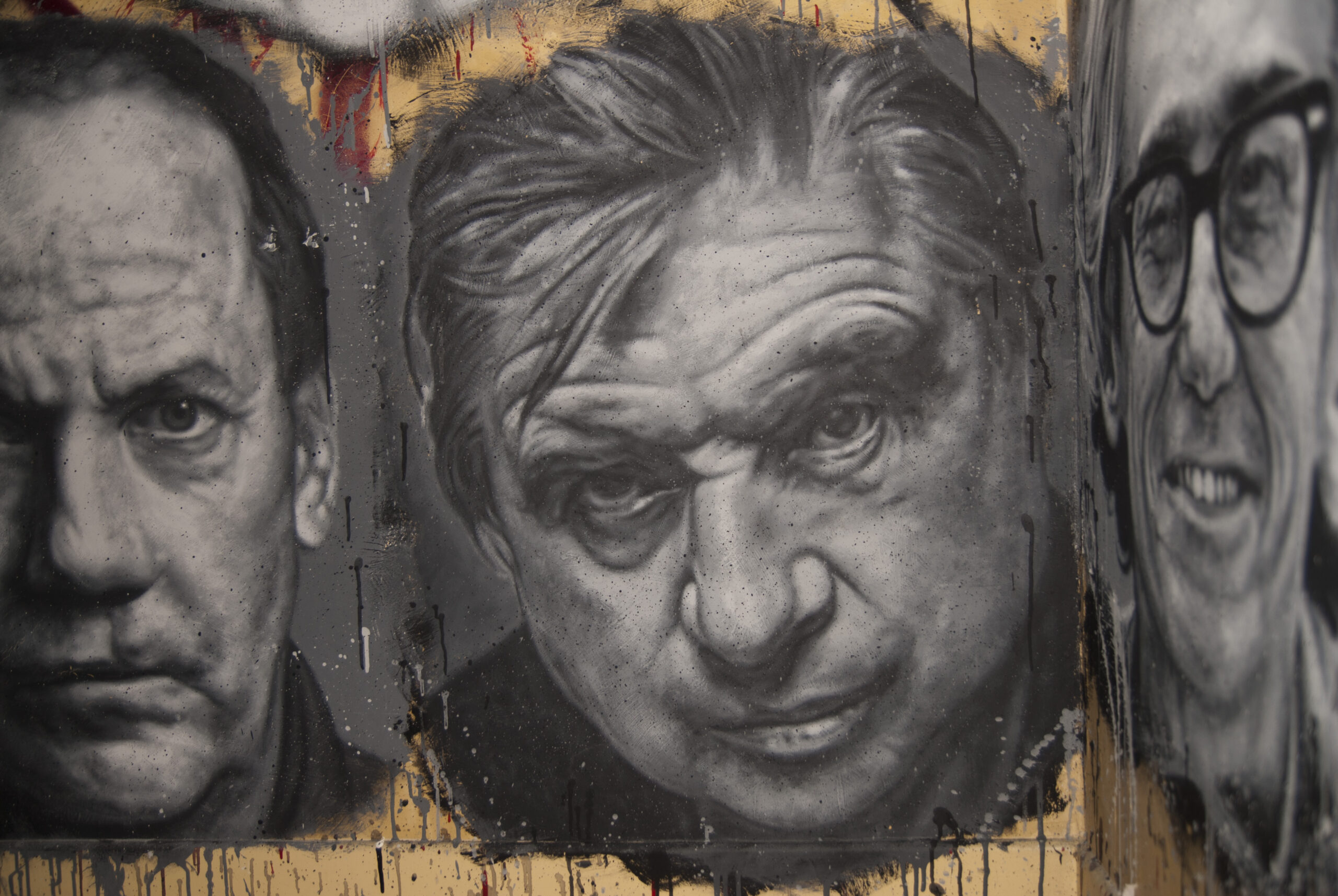
‘The museum-going cannibal:’ On Francis Bacon
On the heels of this month’s Louvre heist, a poet reflects on his own hellish — and oddly heartening — encounter at a famed museum.
Some years ago, while in New York for a few days, I found myself at the Metropolitan Museum of Art, drawn by an uneasy magnetism to the centenary retrospective of Francis Bacon. I knew Bacon’s name and complicated fame: born in Dublin in 1909, he grew up between Ireland and England in a fractious home. Banished by his father for his sexuality by the age of 16, he fled to Berlin and Paris, cities steeped in decadence and trauma. These early wounds bled into his canvases.
“I lived through the revolutionary Irish movement, Sinn Fein, and the wars, Hiroshima, Hitler, the death camps, and daily violence that I’ve experienced all my life. And after all that they want me to paint bunches of pink flowers,” Bacon said in the final interview before his death (conducted in 1991 by Corsican photographer and Bacon portraitist Francis Giacobetti). “But that’s not my thing. The only things that interest me are people, their folly, their ways, their anguish, this unbelievable, purely accidental intelligence which has shattered the planet, and which maybe, one day, will destroy it.”
Those broadly familiar with Bacon’s oeuvre know how disturbing it can be, what a harsh indictment it is of the human condition. I was not, up until my MET visit, one of those people.
My fellow museum-goers and I were greeted by a gallery of 65 unspeakable paintings — nightmarish, horrible, terribly beautiful, of course, but horrible nonetheless — doubled up as giant distorting mirrors, rendering our reflections warped, flayed, and corrupt. These were awful reminders of what was raw, wounded, and wounding in us. Bacon dared us to gaze deeply into our abyss without flinching.
I was struck by the contrast between the horrors hanging on the walls and the civilized people taking them in: endearing, cultured, gentle people straining to recognize their own reflections in the suspended howl of Bacon’s unholy art: crucifixions without standard crosses, resurrections aborted mid-scream. One canvas featured a figure blurred to near oblivion, ribs unraveling into void, mouth fixed in an open refusal. We stood before it as penitents. There was no invitation to interpret. Only the demand to witness.

Hoping to capture this paradox, and armed only with the contents of my pockets after checking my writing bag at the door, I composed my first iPhone poem, “The museum-going cannibal.”
The metaphor of cannibalism felt apropos. Not only because of what Bacon presented us — these grotesque offerings of flesh and anguish — but because of how we received them. They compelled us with sensation, our bodies reacting before intellect arrived: nausea, breathlessness, an impulse to turn away (yet a compulsion to return).
I think of museums, not unlike libraries, as secular sacred spaces that enshrine spirits of the great dead, and some of the living, too, through their artwork. But aesthetic consumption is never without consequence. Museums are sanctuaries of observation, yes, but also storerooms of stolen heritage. Historically, they have displayed bodies as well as art: ritual objects, ancestral remains, cultural fragments, divorced from context and sanctity. To look, sometimes, is to devour.
And with Bacon, the eating is especially tough. The flesh on display is not transubstantiated. There is no bread. No wine. No promise of renewal or myth of ascent.
Only blood. Only bone.
Consider his famed Study after Velázquez’s Portrait of Pope Innocent X. A scream, trapped in papal robes. A sovereign reduced to spectral grief. Instead of revelation, an unraveling. And then, his final painting: Study of a Bull. A white form dissolving into shadow, poised at the brink of extinction. A creature neither entering nor departing, but caught at the moment of disappearance.
Yes, there was something like a negative liturgy at work in Bacon’s gallery. Though a confessed unbeliever, he painted with the intensity of someone chasing a terrible revelation. If his figures are martyrs, they bleed without meaning. If saints, then ones denied the possibility of intercession. And yet, the suffering of these subjects, in their stripped state, retains a kind of majesty, cautioning of perverse unravelings of the human condition. What might become of us in the absence of attention, morality, devotion, and love. Then, there are the museum-goers, myself among them, contemplating our complicity in this demise.
“You can’t be more horrific than life itself,” Bacon liked to remark. That ruthless candor helps explain the force of his vision. Yet, what makes Bacon’s works captivating is that, in spite of their dark, often graphic nature, they signal a kind of faith, one that does not ask for mercy so much as recognition. In that final interview with Giacobetti, Bacon concluded his meditation on war and human destruction with a note of hope: “I am not a pessimist. My temperament is strangely optimistic. But I am lucid.”
From the shriek of the pontiff to the fading outline of the beast, Bacon scrapes us raw. He reaches into the cavity of the self and reveals what lies beneath: nerve, fear, sinew, desire. Difficult, sacred work that reminds us of what’s always at stake in the spiritual battle to remain human.
Observed
View all
Observed
Share on Social


By Yahia Lababidi
 Yahia Lababidi is the author of 12 books of poetry and prose, including Palestine Wail (Daraja Press, 2024) and What Remains To Be Said (2025). His work has appeared on NPR and PBS, and in World Literature Today, The New Arab, and Liberties Journal. An Arab-American of Palestinian background, he explores the intersections of art, spirituality, and moral witness.
Related Posts
Business
Kim Devall|Essays
The most disruptive thing a brand can do is be human
AI Observer
Lee Moreau|Critique
The Wizards of AI are sad and lonely men
Business
Louisa Eunice|Essays
The afterlife of souvenirs: what survives between culture and commerce?
The Observatory Newsletter
Ellen McGirt|Fresh Ink
What happens when the social safety net disappears?
Related Posts
Business
Kim Devall|Essays
The most disruptive thing a brand can do is be human
AI Observer
Lee Moreau|Critique
The Wizards of AI are sad and lonely men
Business
Louisa Eunice|Essays
The afterlife of souvenirs: what survives between culture and commerce?
The Observatory Newsletter
Ellen McGirt|Fresh Ink