


October 12, 2009
Unhappy Homes
I think that Sam Mendes has a decor problem. As I wrote about Revolutionary Road, which he directed, the suburban house in which the Wheelers reside is beautifully decorated in a modern style, but they fail to evince any emotion about their stuff. It is background and the lack of emotion toward their surroundings contributes to the viewers’ difficulty in believing their inflated emotions toward their terrible situation: loss of artistic dream, entombment in suburbia. It is just a set, not a house, not a home, which makes it hard to get sucked in to the characters’ reality. Their cool modern chairs were speaking to me but not, apparently, to the Wheelers.
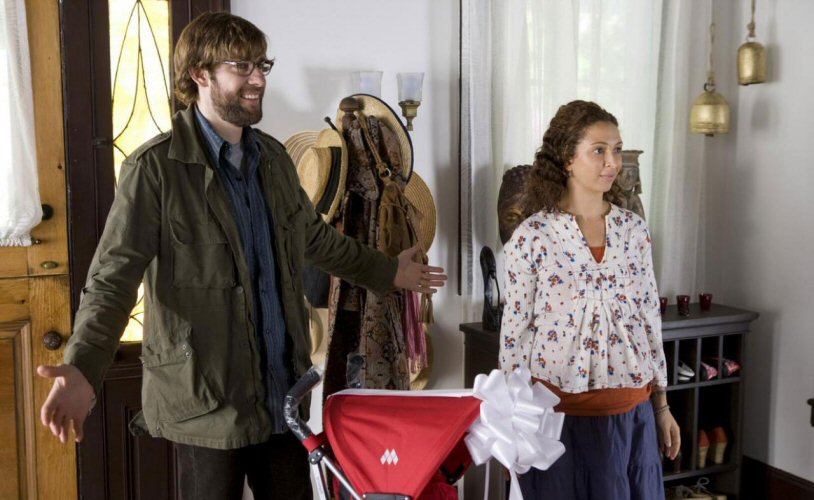
The same problem rears its head in the seeminingly entirely different, but really not so, Away We Go. Like Frank and April Wheeler, Burt Farlander and Verona De Tessant think they are better than the circumstances in which they find themselves. Unlike the Wheelers, they live in the 2000s, so they actually go off in search of a better home (their lucky baby hasn’t been born yet). Their search takes them to Phoenix and Tucson, Madison, Montreal and Miami and in each place they drop in on another caricature of family life, each one set against a densely decorated backdrop. The characters they meet are too weird, too overwritten and too idiosyncratic, to be useful as contemporary satire. But their homes, each one larger than the last, seem to include every decorating cliche on the planet in a vain attempt to ground them in reality.
I know plenty of attachment parents. They hardly need to have a vast family bed, family money and an over-attachment to seahorses to seem terrifying. Maggie Gyllenhaal’s constant plucking at her easy-access tunics told me all I needed to know about LN (formerly Ellen). But it wasn’t just her. Do “loving” parents have to display as much art by their kids as possible to pass muster? Do all homes in Miami come with teal chairs? Burt and Verona seem to be sketched as hipsters (work from home, drive a Volvo, facial hair) but he sells insurance futures and she is a medical artist. To these professions I found it hard to relate, and found them impossible to place. Would a seller of insurance futures really not know the difference between cobbling, carving and whittling? Would they live in a little house full of junk (or was that supposed to be Craigslist irono-junk)?
So many questions… My point is, Burt and Verona and all the people they meet stand in front of their homes like actors in front of a painted backdrop, and the semaphores of sofas and sculptures don’t go with the words being spoken. When Burt and Verona do find their home — and it is a beautiful one — they act as if it has been made just for them. But really, who wouldn’t love an antebellum mansion on the water, beautifully faded to Martha Stewart hues? Their taste doesn’t make them special. And it did not make me love them, or their movie.
Observed
View all
Observed
Share on Social


By Alexandra Lange
 Alexandra Lange is an architecture critic and author, and the 2025 Pulitzer Prize winner for Criticism, awarded for her work as a contributing writer for Bloomberg CityLab. She is currently the architecture critic for Curbed and has written extensively for Design Observer, Architect, New York Magazine, and The New York Times. Lange holds a PhD in 20th-century architecture history from New York University. Her writing often explores the intersection of architecture, urban planning, and design, with a focus on how the built environment shapes everyday life. She is also a recipient of the Steven Heller Prize for Cultural Commentary from AIGA, an honor she shares with Design Observer’s Editor-in-Chief, Ellen McGirt.
Related Posts
Business
Kim Devall|Essays
The most disruptive thing a brand can do is be human
AI Observer
Lee Moreau|Critique
The Wizards of AI are sad and lonely men
Business
Louisa Eunice|Essays
The afterlife of souvenirs: what survives between culture and commerce?
Architecture
Bruce Miller|Essays
A haunting on the prairie
Related Posts
Business
Kim Devall|Essays
The most disruptive thing a brand can do is be human
AI Observer
Lee Moreau|Critique
The Wizards of AI are sad and lonely men
Business
Louisa Eunice|Essays
The afterlife of souvenirs: what survives between culture and commerce?
Architecture
Bruce Miller|Essays