



October 3, 2009
White Knight
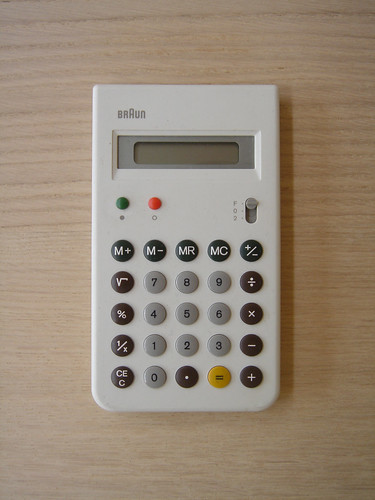
Of all the design classics in my house, the least effort went into the acquisition of the item above: Dieter Rams’s Braun ET44 calculator, 1978, which my husband found abandoned in the drawer of his desk at an architecture office and took home. He didn’t know what it was, just that he liked the feel of the buttons. Originally snowy white, ours has weathered to cream, but the = key remains that delicious mustard color.
As many bloggers before me have pointed out, here is the origin of all things Apple, design-wise. Here too are the coolest electronics ever, appealing to both technophiles and technophobes through sheer tactility, simplicity and (so I am told) good sound. Almost anything designed by Rams and his colleagues at Braun would, if re-released today, automatically be the best-looking thing in the kitchen, bathroom or stereo cabinet. Why do we have a million Eames chairs and I can’t buy this mixer? One of the Rams designs in continuous production is his Vitsoe 606 shelving system: lovely, but so complicated that when it was sold at Design Research they imported white-coated technicians to install it.
I bring up Rams because I just heard the news that an exhibition of his work, Less and More, will open in November at the London Design Museum and that there is an accompanying monograph that was available…and might be again by Christmas. Rams has been in the air for some time as an influence, acknowledged and unacknowledged and my kitchen is a sort of shrine to Rams’s offspring. The current designer who owes him the greatest debt is Jasper Morrison, whose Rowenta coffee maker and toaster are almost pure Rams.
In 2007 Morrison published a book called Super Normal with Naoto Fukasawa, a designer for Muji similarly interested in all things white, plain and functional. The book and accompanying exhibition were a sort of explanation in goods of their aesthetic philosophy, including brand-new items and classics like Luxo lamps. I have that coffee maker, along with Konstantin Grcic’s Krups toaster oven and the Tivoli iSongbook. No, I did not want to pay that much for a toaster. But I realized that I use it and look at it every day and I did not want another off-white, uselessly streamlined Black & Decker on my new white countertop. That’s how they get you and that was Rams’s genius. He created the useful everyday thing that you didn’t have to pay attention to. It was just perfect.
Observed
View all
Observed
Share on Social


By Alexandra Lange
 Alexandra Lange is an architecture critic and author, and the 2025 Pulitzer Prize winner for Criticism, awarded for her work as a contributing writer for Bloomberg CityLab. She is currently the architecture critic for Curbed and has written extensively for Design Observer, Architect, New York Magazine, and The New York Times. Lange holds a PhD in 20th-century architecture history from New York University. Her writing often explores the intersection of architecture, urban planning, and design, with a focus on how the built environment shapes everyday life. She is also a recipient of the Steven Heller Prize for Cultural Commentary from AIGA, an honor she shares with Design Observer’s Editor-in-Chief, Ellen McGirt.
Related Posts

Business
Kim Devall|Essays
The most disruptive thing a brand can do is be human
AI Observer
Lee Moreau|Critique
The Wizards of AI are sad and lonely men
Business
Louisa Eunice|Essays
The afterlife of souvenirs: what survives between culture and commerce?
Architecture
Bruce Miller|Essays
A haunting on the prairie
Related Posts
Business
Kim Devall|Essays
The most disruptive thing a brand can do is be human
AI Observer
Lee Moreau|Critique
The Wizards of AI are sad and lonely men
Business
Louisa Eunice|Essays
The afterlife of souvenirs: what survives between culture and commerce?
Architecture
Bruce Miller|Essays